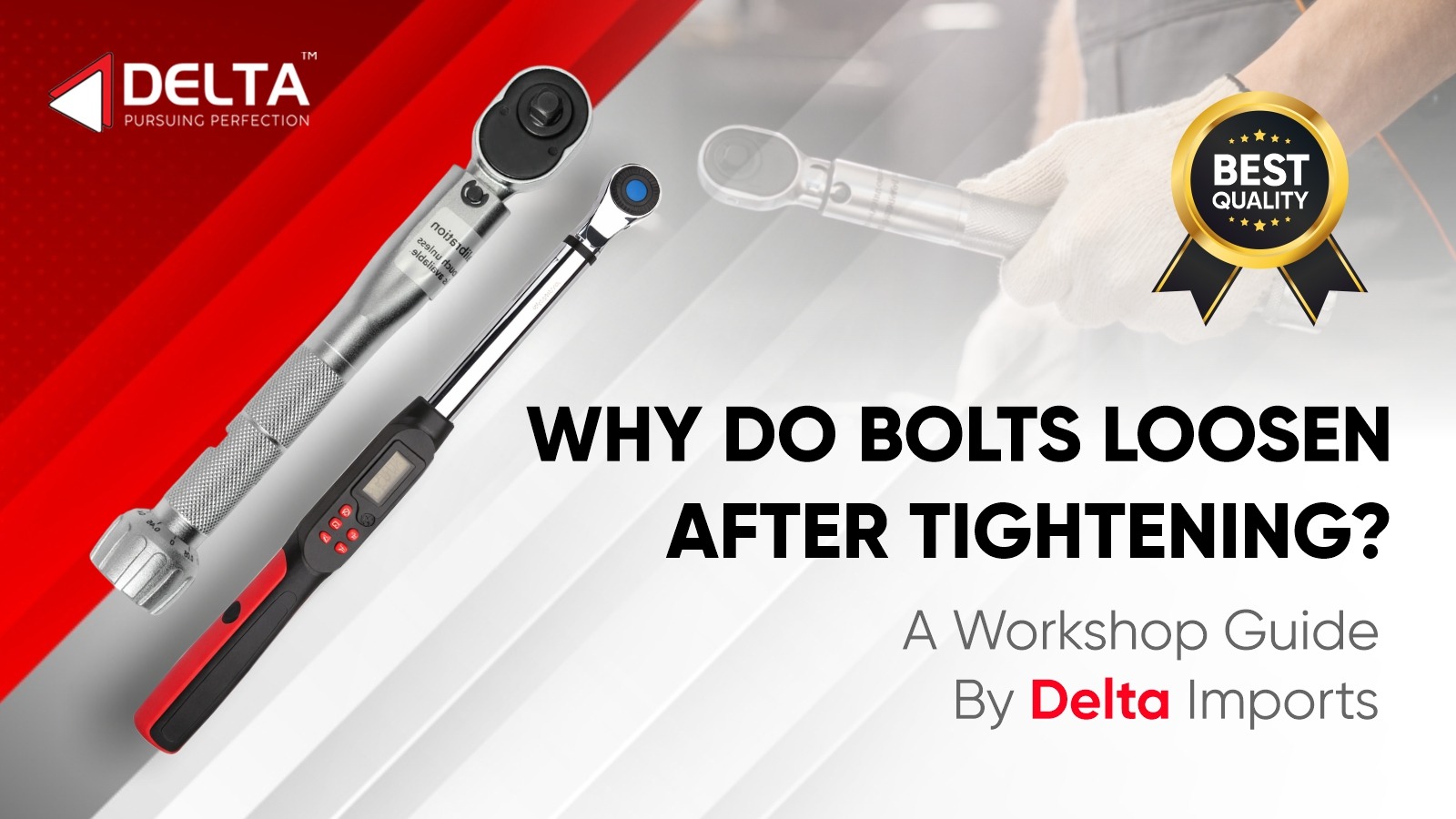
Why Do Bolts Loosen After Tightening? A Workshop Guide By Delta Imports
If you run an automotive workshop or handle industrial maintenance, you have probably faced this:
● A vehicle comes back after service
● A flange starts leaking after installation
● A machine begins vibrating after overhaul
Technicians confirm the bolts were tightened properly — yet the fasteners become loose again.
This is a very common problem in automotive workshops, fabrication shops and industrial maintenance plants across India. Many service centres now consult a torque wrench dealer In India workshops rely on to understand proper tightening practices and tool selection.
In most cases, the issue is not the mechanic and not the bolt.
The real cause is uncontrolled tightening.
Tightening a Bolt Is Not About “Force”
Many technicians tighten bolts until they feel tight. But in engineering, bolts are not tightened for tightness — they are tightened to create clamping force.
A bolt actually behaves like a spring.
When the correct torque is applied, the bolt stretches slightly and clamps two parts together with constant pressure. This pressure is called preload.
If the torque is incorrect:
● vibration starts
● gaskets leak
● joints shift
● bolts slowly loosen
Even a small torque variation can drastically reduce clamping force.
The Two Most Common Bolt Tightening Failures
1) Under-Tightening When torque applied is less than required.
Results:
● wheel nut loosening
● flange leakage
● part movement
● repeat customer complaints
2) Over-Tightening When excessive torque is applied.
Results:
● stretched bolts
● damaged threads
● sudden bolt breakage
● expensive component failure
Both problems occur when tightening is done without torque measurement.
Why This Happens in Most Workshops
In real workshops, the following practices are very common:
Tightening by feel
Human judgment cannot measure torque accurately.
Using impact guns for final tightening
Impact tools are fast but not controlled. They are designed for removal and running bolts, not final torque.
Wrong torque range tools
Using a large torque wrench on small fasteners reduces accuracy drastically.
No calibration
Torque tools lose accuracy over time and require periodic calibration.
Because of this, professional service centres are now moving to measured tightening using calibrated tools. Many service centres now consult a torque wrench dealer India workshops rely on to understand proper tightening practices and tool selection.
Where Bolt Loosening Problems Occur
Most Workshops frequently experience loosening in:
● wheel nuts
● cylinder head assembly
● gearbox housings
● pumps & compressors
● hydraulic flanges
● industrial machinery installation
In factories, improper tightening is also a hidden cause of bearing failure, vibration and misalignment.
The Real Solution: Torque-Controlled Tightening
Professional maintenance teams follow a controlled tightening process:
1. Apply specified torque value
2. Follow correct tightening sequence
3. Use proper torque range tool
4. Verify tool calibration
Benefits Workshops Notice After Using Proper Torque Tools
● fewer repeat complaints
● reduced warranty rework
● improved safety
● longer component life
● better customer trust
Why a Torque Wrench Is Important for Workshops
A torque wrench ensures that the bolt receives the exact amount of force recommended by the manufacturer.
It prevents:
● under-tightening
● over-tightening
● thread damage
● premature part failure
For automotive workshops and industrial maintenance teams, a torque wrench is not just a tool — it is a quality control instrument
Choosing the Right Torque Tool
While selecting a torque wrench, workshops should consider:
● correct torque range
● calibration support
● industrial durability
● application type (automotive / industrial / assembly)
Instead of choosing tools randomly, many maintenance teams prefer guidance from a trusted torque wrench dealer India professionals depend on, so the correct tool is selected according to application and required torque value.
For precision applications, workshops increasingly adopt a digital torque wrench with calibration because it provides measurable accuracy, repeatability and service reliability.
How Delta Imports Helps Workshops
Modern workshops are no longer judged only by how quickly a job is completed — they are judged by whether the problem stays fixed. Customers expect reliability, not repeat visits. That is why proper tightening equipment, especially calibrated torque tools, has become essential in professional service centres.
Delta Imports supports workshops and maintenance teams by supplying professional-grade torque and maintenance equipment designed for regular industrial and automotive use.
By adopting correct tightening practices, workshops can:
● reduce repeat failures and comebacks
● improve safety for vehicles and machinery
● enhance service quality and workshop reputation
● build long-term customer trust